There are a lot of dogs in San Francisco. Walk almost any neighborhood in the morning and you’ll see them, and most cafes will hand you a water bowl without being asked. But the city is hilly and the weather changes block to block, so a neighborhood that looks fine on a map can feel different once you’re actually out walking at 7 a.m. in the fog.
If you’re apartment hunting with a dog, where you live matters as much as the apartment itself. These are the neighborhoods that make it easiest, starting with the three that come up most.
Which San Francisco neighborhoods are best for dog owners?
Pacific Heights, the Marina, and Nob Hill. Pacific Heights has two parks inside the neighborhood itself. The Marina has the most open waterfront grass in the city. Nob Hill has less room to run but packs almost everything into a short walk. Here’s what each is like day to day.
Pacific Heights
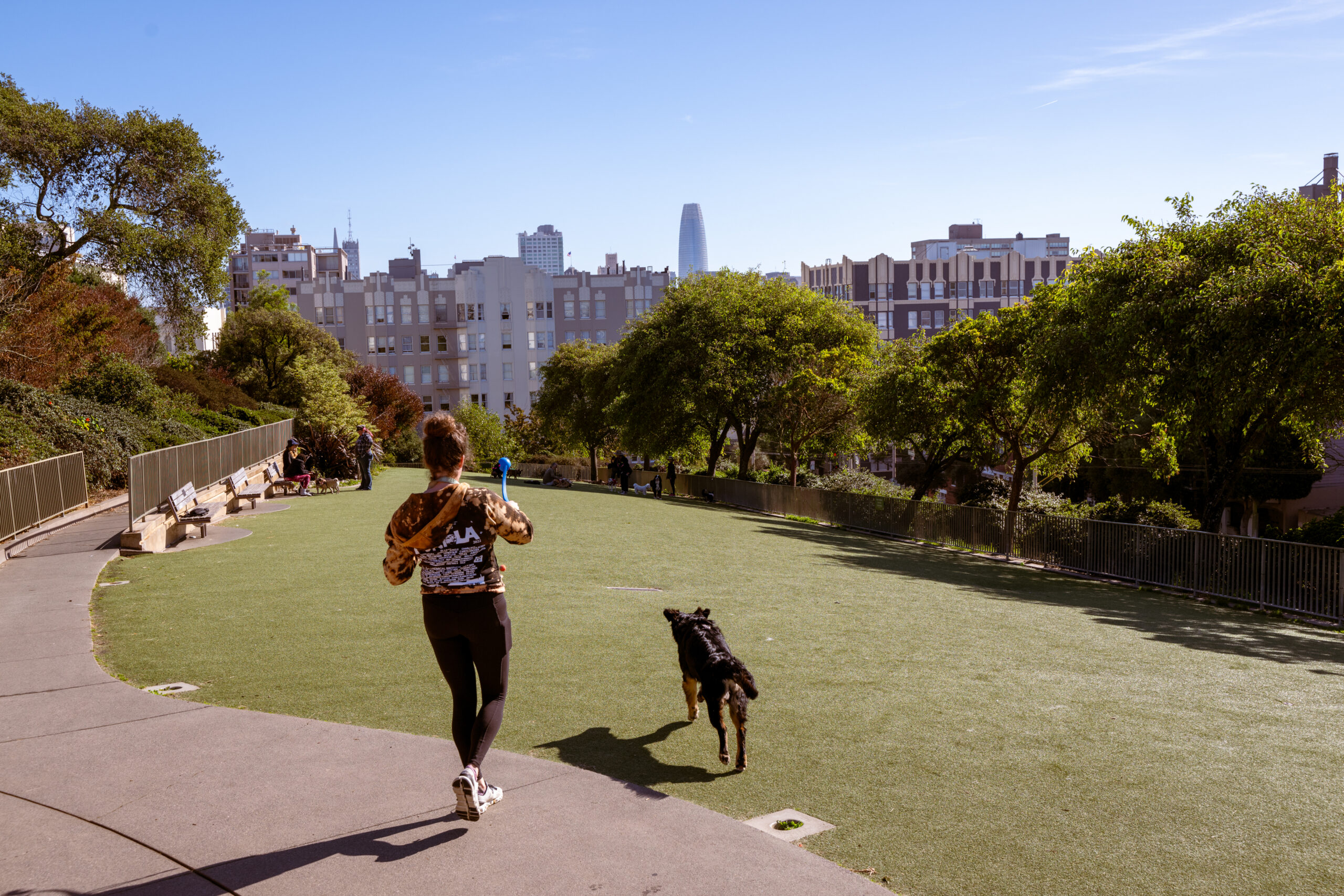
Pacific Heights has two parks inside the neighborhood, not just nearby. Lafayette Park has a fenced dog area with turf, water bowls, and waste bins, on a slope steep enough to tire a dog out. One thing to know: it’s fenced on three sides and open at the entrance, so keep an eye on a dog that likes to bolt. Alta Plaza Park, a few blocks over, has an off-leash area near the southeast corner and views out to the bay from the top.
Between the two, you’ve got somewhere to go every day, which isn’t true of most of the city. Fillmore Street has the cafes and patios where a dog can sit while you eat. The catch is price. Pacific Heights is expensive, so it makes the most sense if you’ll actually use the parks.
Best for: dog owners who want green space in walking distance
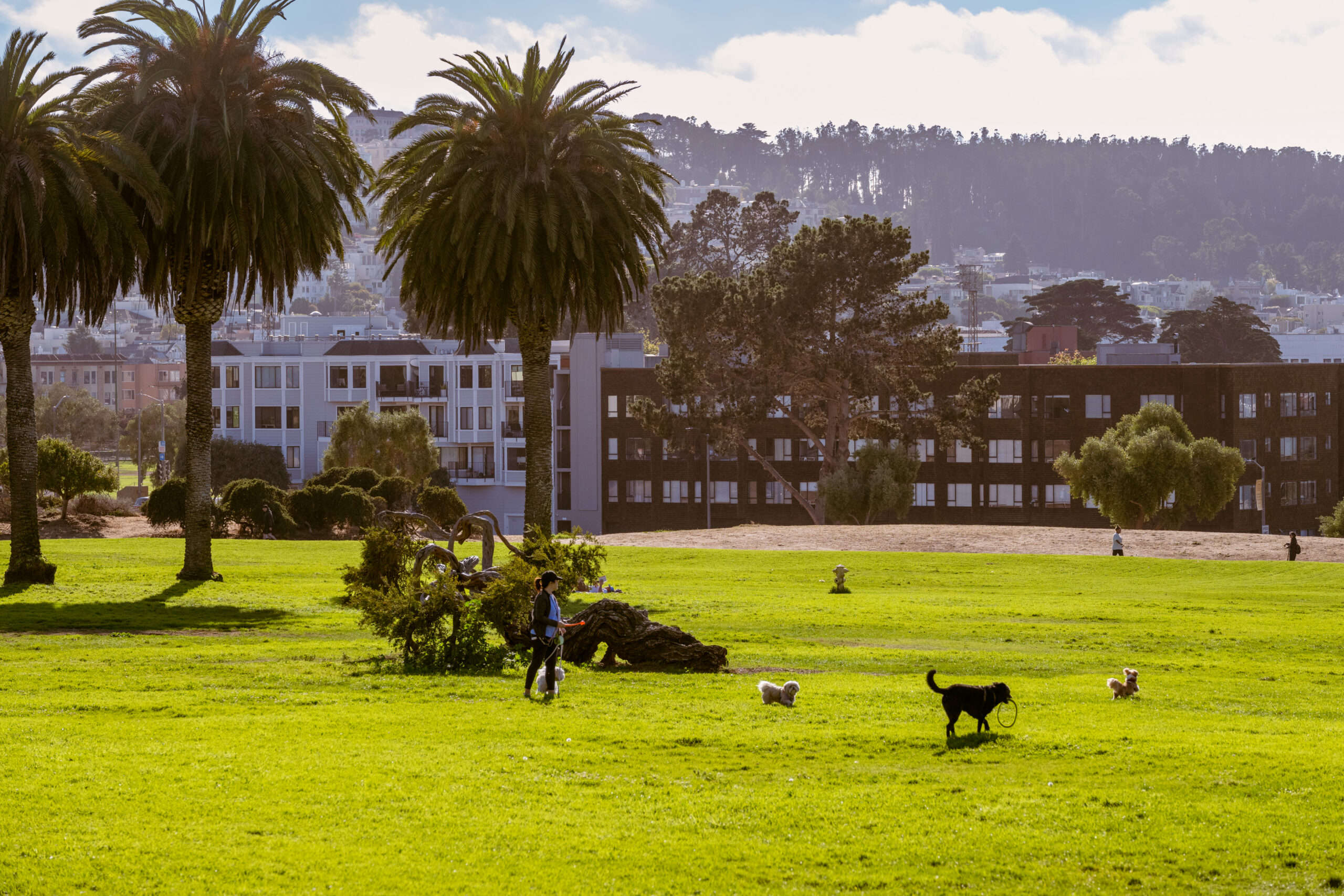
If your dog needs to run, go to the Marina. Marina Green is a long, flat stretch of grass along the water between Fort Mason and the Presidio, with more open room than you’ll find almost anywhere else in the city. Dogs are supposed to be leashed, but there’s space to spare. Walk east and you hit the Great Meadow at Fort Mason; walk west and you reach Crissy Field, where the beach turns into off-leash sand with the Golden Gate Bridge behind it.
The neighborhood is mostly flat, which adds up when you’re walking a dog a few times a day. Chestnut Street covers errands and patio meals, and most places are used to dogs. The wind off the bay is the real downside. Some dogs don’t care, some want a sweater.
Best for: high-energy dogs, and anyone who wants flat streets and water walks.
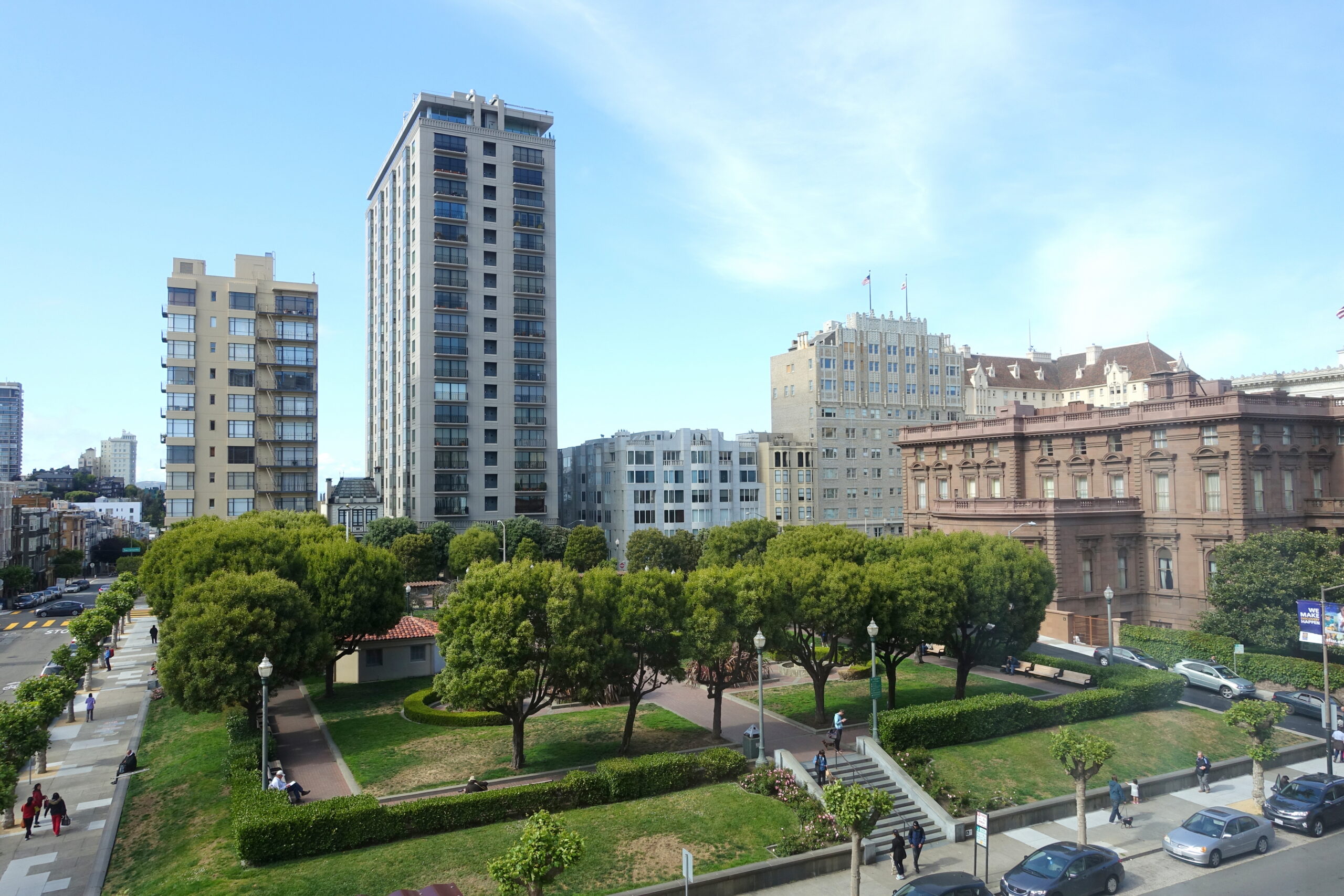
Nob Hill trades yard space for location. There’s less room to run, but almost everything is a short walk. Huntington Park, across from Grace Cathedral, is a single block of grass with a fountain and benches, and there are local dogs there most of the day, a lot of them small breeds. It’s on-leash and better for a walk and some socializing than a real run.
The hills are steep. Most blocks go uphill, though Bush Street stays mostly flat if you want an easier loop. Polk Street, on the west side, has the restaurants and dog-friendly outdoor seating. For off-leash time you’ll head down to Francisco Park or toward the water, but as a home base it’s walkable and full of character.
Best for: people who want a central, older neighborhood and don’t mind the hills.
Get the building’s pet policy in writing, including weight or breed limits and pet rent. Ask how far the nearest real off-leash spot is, not just the closest grass. And walk the route yourself at the time of day you’d actually use it, since the fog and wind shift from block to block.
San Francisco is expensive to rent in. That part isn’t news. But expensive doesn’t mean hopeless, and most of the advice online is either vague or a few years out of date. Below is the practical version: where to look, what the rules actually are, and how to give yourself an edge without moving an hour outside the city.
Quick answers
Lowest-rent neighborhoods with good transit: Dogpatch, Bayview, Visitacion Valley, Excelsior, Outer Mission, Glen Park
Rent control applies to apartments in buildings with two or more homes, built on or before June 13, 1979
If your home is rent controlled, your rent can go up 1.6% this year. On $2,500 rent, that is about $40 more a month.
If it is not, state law still caps most increases at 10% a year and requires a legal reason to evict you.
Income-restricted housing: apply through the DAHLIA portal, run by the Mayor’s Office of Housing and Community Development
Sharing a two-bedroom usually lowers your monthly cost more than changing neighborhoods does
What counts as affordable housing in San Francisco?
Affordable housing means two different things here, and mixing them up costs people time.
The first is lower-cost market-rate housing: ordinary apartments that happen to rent below the city average, usually because of location, building age, or how long a home has sat vacant. Anyone can rent these. Most people searching for affordable housing want this.
The second is Below Market Rate (BMR) housing, which is income-restricted, priced under market, and administered by the city through an application and lottery process. You have to qualify by household income and household size.
If you are not sure which one applies to you, start with market-rate. The BMR process runs on its own timeline and is worth entering in parallel rather than waiting on.
Which San Francisco neighborhoods have the lowest rents?
Rent tracks demand, so the fastest way to lower yours is to look where fewer people are looking. The Mission, Pacific Heights, and the Marina stay expensive because they stay popular. These neighborhoods run cheaper and still connect to downtown:
Dogpatch – waterfront, industrial-turned-residential, on the T-Third line
Bayview – among the lower average rents in the city, T-Third access, more space per dollar
Visitacion Valley – quiet and residential at the southern edge, T-Third and Caltrain nearby
Excelsior – family-oriented, strong food scene on Mission Street, BART at Balboa Park
Outer Mission – more square footage for the money, BART at Balboa Park
Glen Park – a middle option, quieter and residential, with its own BART stop and a short ride downtown
The tradeoff is usually commute time or fewer restaurants and bars within walking distance. These neighborhoods vary block to block, so walk the actual streets before you decide, ideally once on a weekday evening and once on a weekend.
Does getting a roommate actually lower your rent?
Yes, and usually by more than any other single change you can make. A room in a shared two- or three-bedroom typically costs well below a studio in the same neighborhood, and utilities and internet split across more people on top of that.
A few things to handle up front. Everyone living in the home should be named on the lease and screened as a co-tenant, which protects you if a roommate leaves and keeps your tenancy in good standing. Ask the property manager how they handle adding a roommate later, since policies differ and some buildings do not permit arrangements where an unapproved person moves in. Agree on how you will split rent, deposit, and utilities before you sign, not after.
How does rent control work in San Francisco?
San Francisco rent control generally covers apartments in buildings with two or more homes, built on or before June 13, 1979. For covered homes, your landlord can raise the rent only once every 12 months, by a percentage the Rent Board sets each year.
For March 1, 2026 through February 28, 2027, that allowable increase is 1.6%. The prior year it was 1.4%. The figure is tied to Bay Area inflation and has stayed well below what the open market does.
Four things worth knowing:
Coverage follows the building, not the tenant. Two similar apartments on the same block can have completely different rules based on construction date.
Single-family homes and condos are generally exempt from rent increase limits under Costa-Hawkins, though eviction protections still apply to most San Francisco tenants.
Listings almost never advertise rent control, even when a home qualifies. It is on you to ask.
You can verify a building’s construction date yourself on the city’s Property Information Map, and the SF Rent Board has counselors who answer tenant questions at no cost.
Even outside local rent control, California’s AB 1482 caps annual increases on many newer homes at 5% plus regional inflation, capped at 10% total, and requires a just-cause reason for eviction. You may have more protection than you think. When something seems off, check with the Rent Board rather than taking anyone’s word for it.
How do you qualify for below market rate (BMR) housing?
BMR homes are priced below market and reserved for households under a set income threshold, which changes by household size and is published annually as a percentage of Area Median Income.
Start at the DAHLIA housing portal, which lists BMR rentals, lotteries, and current income limits. The San Francisco Mayor’s Office of Housing and Community Development administers the program.
These listings run on application windows and lotteries rather than first-come availability, so get into the system before you need to move. There is no cost to apply and no downside to being in the pool early.
What do you need to apply the same day?
In this market, speed matters more than search volume. Good listings move in days, and the applicant who is ready usually gets the home. Have these assembled before your first tour:
Photo ID for every adult applicant
Proof of income, typically recent pay stubs, an offer letter, or bank statements if you are self-employed
A recent credit report, or willingness to authorize a check
Contact information for your last one or two landlords
Guarantor or cosigner details, if you plan to use one
Funds available for the deposit and first month
Set listing alerts instead of refreshing manually. Ask directly about move-in specials, since some buildings discount the first month or reduce the rate on a home that has been sitting.
What should you ask before signing a lease?
Was the building built on or before June 13, 1979?
What is included in rent, and what is billed separately? Water, trash, parking, and storage are common add-ons.
What is the deposit, and under what conditions is it returned?
How are maintenance requests submitted, and what is the typical response time?
What is the policy on adding a roommate later?
Is renters insurance required, and at what coverage level?
Are there fees beyond rent, such as an annual Rent Board fee split between tenant and landlord?
Get the answers in writing where you can. A property manager who answers these clearly is usually a property manager who handles the rest of the tenancy the same way.
Working with a property manager directly
Searching listing aggregators means competing with everyone else who found the same post at the same time. Going straight to the company that manages the building removes a step.
Brick + Timber manages homes across San Francisco, Berkeley, and Parkmerced. Current availability, pricing, and photos are on rentbt.com. Tell us your budget and the neighborhoods you are considering, and we can point you toward what fits.
What is the cheapest neighborhood to rent in San Francisco? Bayview, Visitacion Valley, and the Excelsior generally have the lowest average rents among neighborhoods with direct transit access to downtown.
How much can rent go up in San Francisco each year? For rent-controlled homes, 1.6% between March 1, 2026 and February 28, 2027. For homes covered by AB 1482 instead, 5% plus regional inflation, capped at 10%.
How do I know if my apartment is rent controlled? Check the building’s construction date on the San Francisco Property Information Map. If it was built on or before June 13, 1979, has two or more homes, and is not a condo or single-family house, it is likely covered. The SF Rent Board confirms status by phone at no cost.
Do I need to earn a certain amount to rent in San Francisco? Most property managers look for gross monthly income around three times the rent, though a guarantor or additional deposit can work as an alternative. Requirements vary by building.
How long does it take to find an apartment in San Francisco? Renters with documents ready usually secure something within two to four weeks. Renters who assemble paperwork after they start touring typically take longer, because well-priced homes are claimed within days.
Fall into winter is one of the best stretches to be in San Francisco. The air turns crisp, the light goes gold, and the neighborhoods fill up with things to do. From free music in the park to long-running holiday traditions, here’s what’s happening across the city from October through December, plus where to go before and after each one. If you’re apartment hunting while you’re out, our new site has real-time availability and neighborhood guides to make exploring easier.
October
Hardly Strictly Bluegrass — Fri to Sun, Oct 3 to 5. A free festival in Golden Gate Park with dozens of artists across several stages. Bring a blanket, layers, and low chairs. Grab and go: sandwiches on the way from Hayes Valley or the Richmond.
Fleet Week — Sat and Sun, Oct 11 to 12. Jets over the bay, the Parade of Ships, and waterfront concerts. Best viewing is along Marina Green and Aquatic Park. Before or after: walk Chestnut Street in the Marina for coffee and dinner.
Halloween week — late October. Family block parties, themed bar nights, and neighborhood trick-or-treating. Noe’s Fair Oaks Street and the Mission’s Shotwell and Castro Streets are the ones to know. Tip: carve pumpkins three to five days before the 31st. They last longer in our cool weather.
November
Día de los Muertos — Sun, Nov 2. Community altars at Garfield Park and a procession through the Mission. Respectful and beautiful. While you’re there: the murals and taquerias in the Mission.
Union Square Ice Rink — opens early November. Downtown skating with holiday music and theme nights. Book your slot in advance. Pair it with: Ferry Building snacks, or tea at the Westin St. Francis.
Embarcadero Center Building Lighting — mid November. The four towers light up to start the holidays, some years with fireworks and a street-fair feel. Before or after: walk North Beach and take the Filbert Steps down toward the Embarcadero for views of the Bay Lights.
Fairmont Gingerbread House Opening — Sat, Nov 22. The Fairmont’s life-size gingerbread house returns in Laurel Court, built from thousands of cookies and candies. Tip: go early to beat the lobby lines, and reserve ahead if you want afternoon tea.
December
Great Dickens Christmas Fair — early to late December. Victorian London at the Cow Palace, with food, shops, and performances.
The Nutcracker at the War Memorial Opera House — early to late December. A local tradition since 1944 and a good excuse for a dress-up night downtown. Before the show: dinner in Hayes Valley.
Lighted Boat Parade — mid December. Decorated boats cruise the northern waterfront. Good vantage points near Fisherman’s Wharf and the Marina. Make a night of it: warm drinks on Ghirardelli Square and sunset at Fort Mason.
Haas-Lilienthal House Holiday Hello — Fri, Dec 20, 4:00 to 7:00 PM. Step inside an 1886 Queen Anne Victorian decked out for the season, with live music and festive treats. Architectural detour: walk over to Russian Hill for postcard streets and views.
Make the season yours
From October’s blue skies to December’s lights, the season here is full of things worth showing up for. Whether you’re under the Embarcadero towers with a cocoa or taking photos in front of one of the city’s lit trees, San Francisco feels close-knit this time of year. If you’re checking out neighborhoods between events, our refreshed site makes it easy to see real-time availability, find nearby cafes and parks, and book a tour.